
Large-scale government transformation program
Modernizing Onboarding for
a Complex Public Service System

Led the design of a future-state recruitment ecosystem, transforming fragmented processes into a unified, data-driven experience platform.
The Role.
Lead UX Designer / Service Designer
-
Product Design / AI-Driven UX / UX Strategy / Service Design / Personas / End-to-End Ownership / User Journey Map / Stakeholder Interviews / Facilitating Workshops / Workflow Design / Process Modeling / Idea Jam / System Thinking / MVP Strategy / User Flows / Wireframing / Prototyping / Visual Design / Icon Design / Interaction Design / Data-Informed Design / Automation Design / User Testing / Marketing / Accessibility (WCAG) / Design Guidelines
The Clients.
Public Sector Organization (Confidential)

Overview.
A large‑scale public sector organization faced fragmented, policy‑heavy recruitment and onboarding processes, creating limited visibility across the end‑to‑end service journey.
I led the definition of a future‑state recruitment and onboarding ecosystem, reframing disconnected workflows into a cohesive, system‑driven service spanning workforce planning, attraction, selection, and training.
Beyond usability, this work focused on system‑level strategy and design leadership, establishing how the service should behave, scale, and evolve as a sustainable platform, not just a set of interfaces.

The Challenges.
Onboarding wasn’t a single journey.
It was a network of processes, decisions, and dependencies.
01
Multiple systems with no shared structure
02
Manual coordination across teams
03
Limited visibility into user progress
04
Inconsistent experiences across touchpoints
As complexity increased, efficiency and clarity decreased.
The organization needed more than optimization.
It needed a new foundation.
The Approach.
We approached this as a system design problem, not just a UX problem.
Understand the Experience.
Built onboarding personas
Mapped end-to-end service journeys
Identified friction points and system gaps
Define the System.
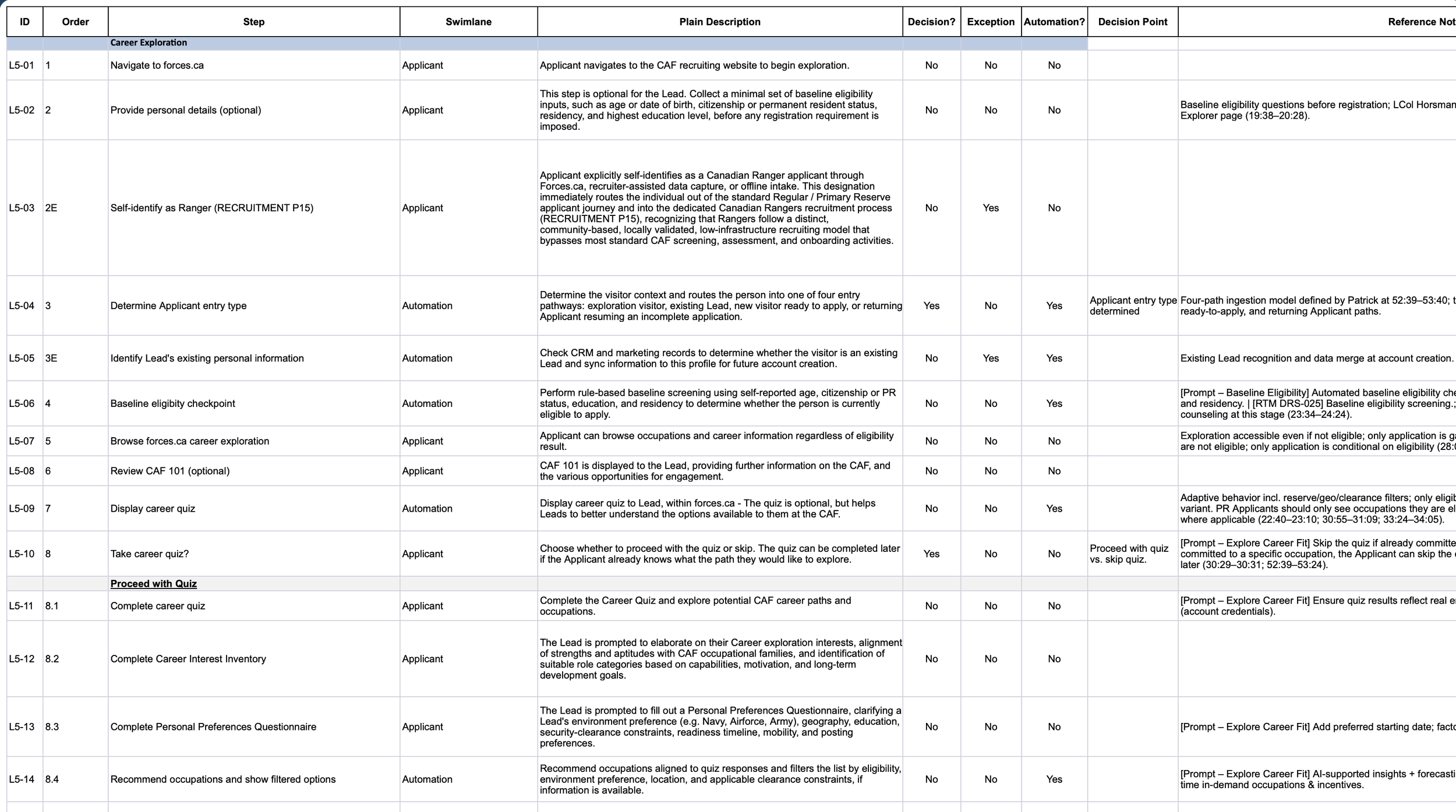
Developed Requirements Traceability Matrix (L3 → L5)
Differentiated business vs technical requirements
Prioritized backlog for MVP
Design the Flow.
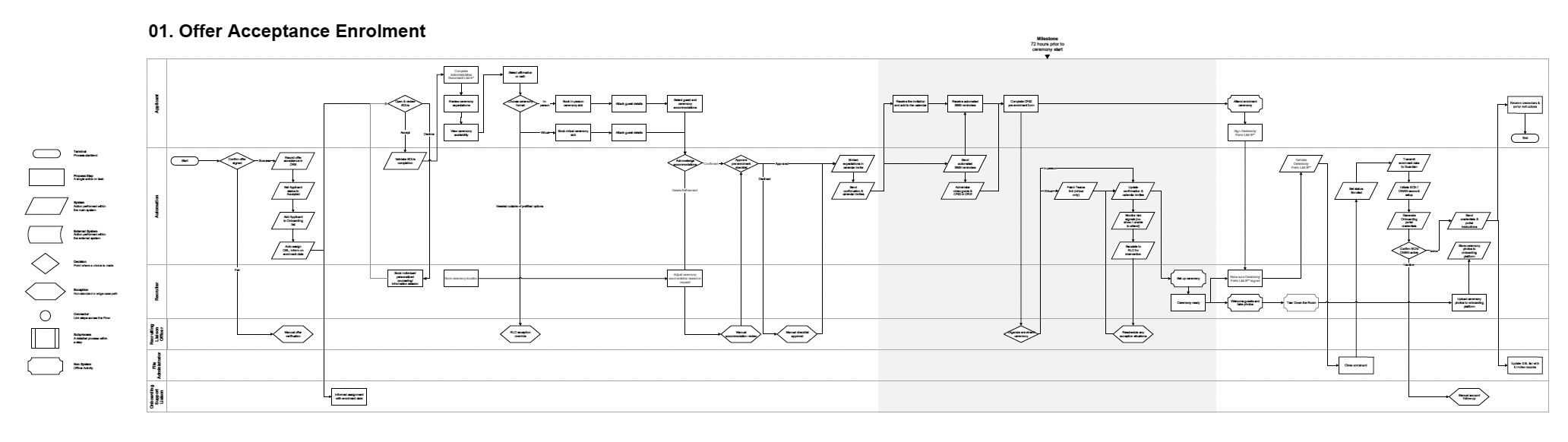
Created detailed onboarding process flows
Modeled decision points, exceptions, and parallel processes
Aligned flows with platform capabilities.
Plan for Delivery.
Defined MVP scope
Designed release roadmap
Established feedback and governance model
Future State
Experience Design.
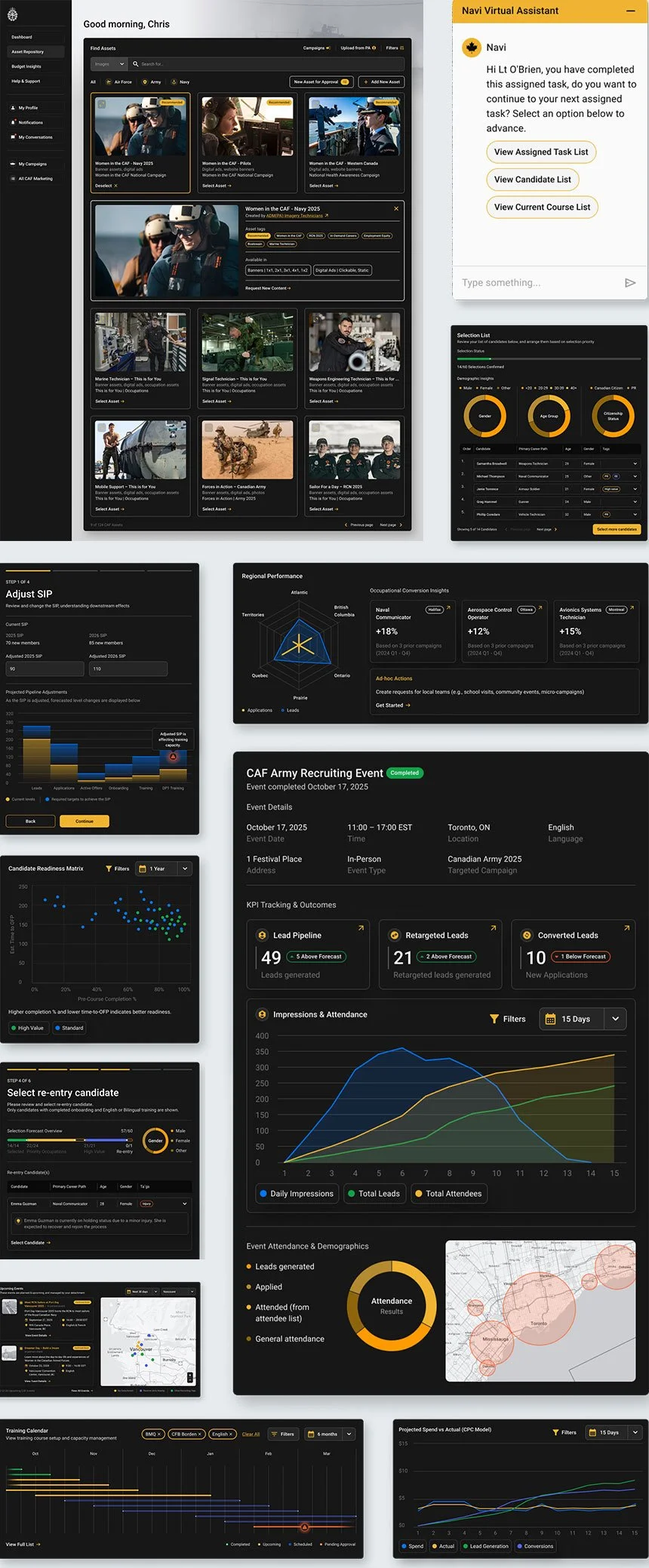
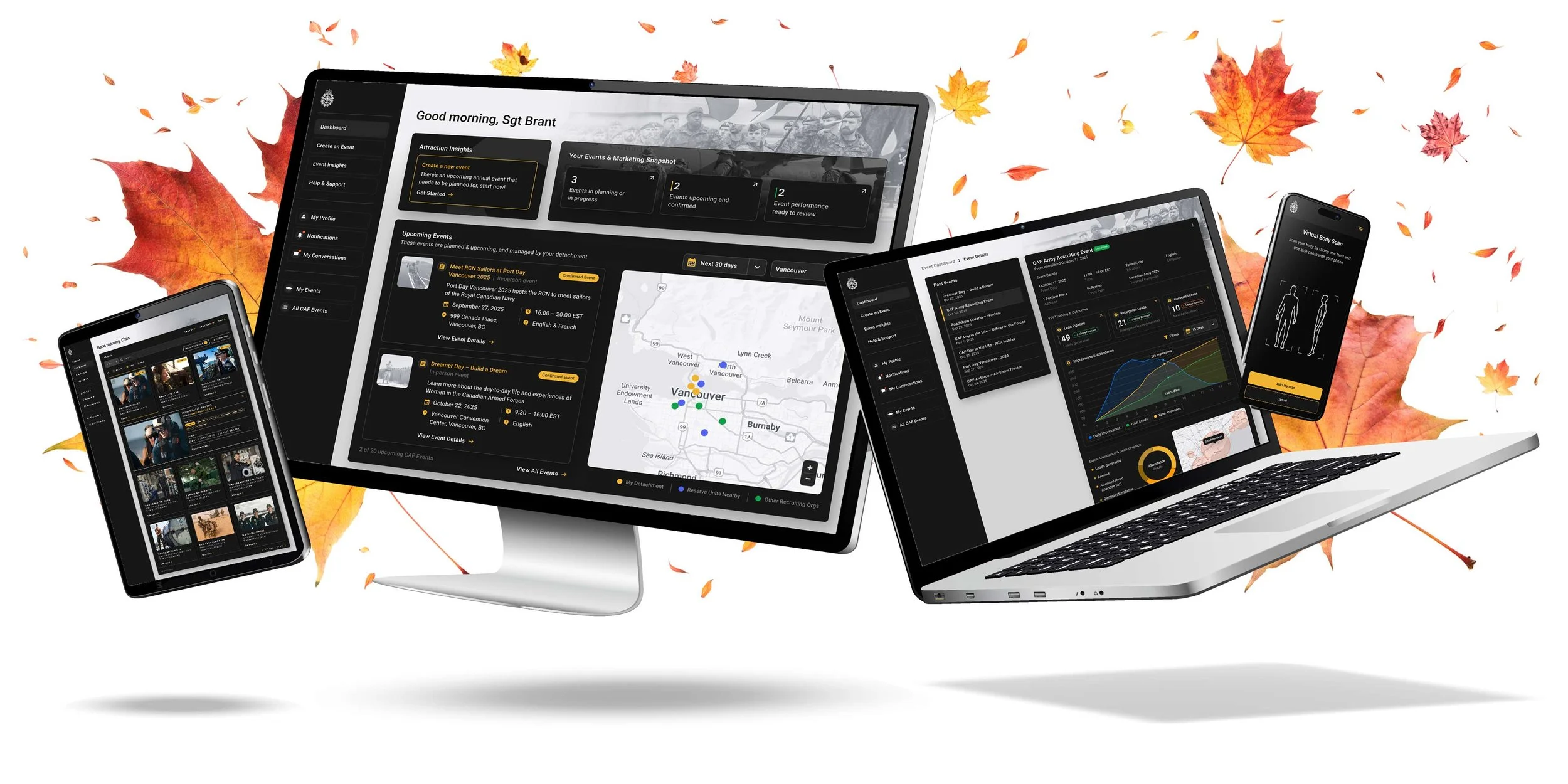
To operationalize the transformation vision, developed a series of experience vignettes (high-fidelity, narrative-driven journeys that simulate how the future system functions across roles, data, and touchpoints)
These vignettes were not presentation artifacts.
They acted as decision-making tools, enabling stakeholders to validate complex workflows before implementation.
The Key Experiences.
Force Forecasting Experience.
Reimagined workforce planning as a dynamic, data-driven capability, integrating pipeline signals and demand forecasting into real-time decision systems.
Event & Attraction Planning.
Designed an insight-driven campaign orchestration model, linking recruiting demand with event strategy, targeting, and execution.
Offer, Selection & Enrollment.
Built a transparent, AI-assisted candidate journey, improving decision clarity while reducing operational friction.
Advertising & Marketing Engine.
Defined a scalable campaign infrastructure supporting approvals, deployment, and performance tracking across distributed teams.
Training List Management.
Connected recruitment outputs with training capacity, enabling synchronized planning across multiple stakeholders.
Process Flow Design.
Designing for Complexity.
Onboarding involved multiple parallel processes, not a linear flow.
We designed for:
Multi-step validation and eligibility logic
Parallel evaluation workflows across different streams
Exception handling and dynamic status changes
State transitions across a long-running journey
Instead of simplifying the system artificially,
we designed clarity within complexity.
The Impact.
Redefined the role of design within the program:
Shifted UX from documentation to strategic decision enablement
Enabled cross-functional teams to align on a shared future-state model
Reduced ambiguity in system design by introducing testable experience frameworks
Influenced platform direction by defining how the system operates at scale
This project shifted the role of design from interface to infrastructure.
From.
Designing screens
To.
Designing systems
Defining logic
Enabling transformation
Designing complex public sector systems by bridging UX, service design, and enterprise architecture.
The Learning.
Designing for complexity requires system thinking, not just screens
Learned to structure fragmented processes into scalable, end-to-end service systems across multiple stakeholders.
Clarity drives alignment in ambiguous environments
Used flows and visual artifacts to turn unclear requirements into shared understanding and faster decision-making.
Real impact comes from balancing user needs with operational reality
Designed solutions that are not only user-centered but also feasible within real-world constraints and processes.